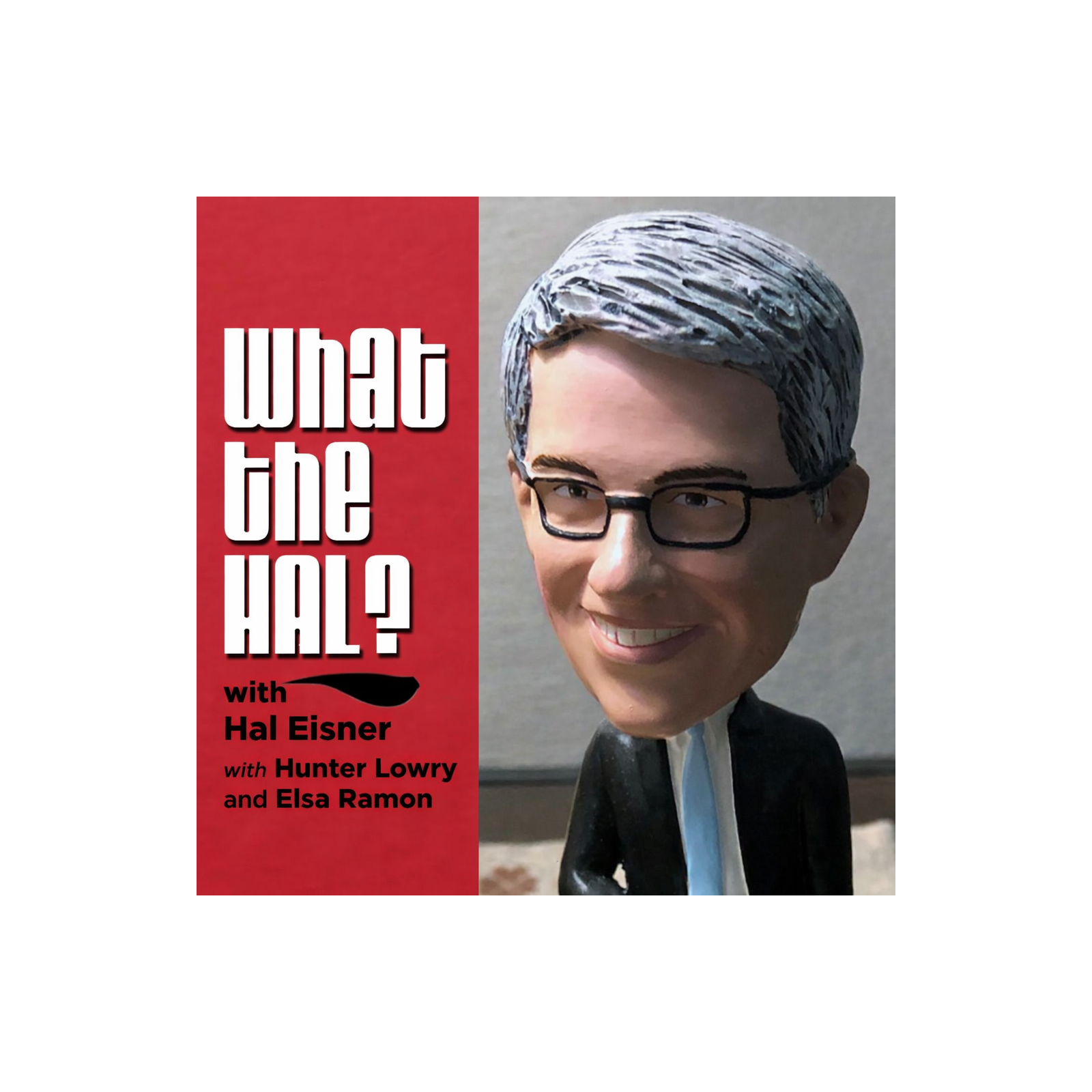
WHAT THE HAL? PODCAST 2.0 – EPISODE 25: Saving Mountain Lions and Reconnecting California's Wilderness
WHAT THE HAL? PODCAST 2.0 – EPISODE 25
Wildlife Overpass: Saving Mountain Lions and Reconnecting California's Wilderness
Every year, countless wild animals risk their lives crossing highways that divide their natural habitats. In Southern California, the struggle has become especially urgent for mountain lions living in the Santa Monica Mountains, where busy freeways have isolated populations and threatened their long-term survival. Now, one groundbreaking project is offering new hope.
In this episode, Hal Eisner, Elsa Ramon, and Hunter Lowry speak with Beth Pratt, founder and president of the Wildlife Crossing Fund, about the Wallace Annenberg Wildlife Crossing being built over the 101 Freeway in Agoura Hills, California. Beth shares the extraordinary effort behind the project, from decades of wildlife research and engineering challenges to fundraising and the remarkable influence of Los Angeles' beloved mountain lion, P-22.
The conversation explores how wildlife crossings protect animals and motorists, why habitat connectivity is essential for genetic diversity, and what makes this project different from other crossings around the world. Beth also discusses plans for future wildlife crossings, how cameras will document animals using the new bridge, and how the public can support efforts to reconnect fragmented habitats.
KEY TOPICS
• The Wallace Annenberg Wildlife Crossing and its importance to Southern California wildlife
• How freeways fragment habitats and threaten mountain lion populations
• The legacy of P-22 and his role in bringing public attention to wildlife connectivity
• Why genetic diversity is essential to the survival of isolated mountain lions
• How scientists determine where wildlife crossings should be built
• The engineering challenges of constructing a wildlife bridge over the busy 101 Freeway
• How vegetation, sound barriers, and fencing help animals cross safely
• The role of private donations, conservation funding, and public partnerships
• Plans for wildlife crossings across California and beyond
• Wildlife cameras, the anticipated opening, and how the public can get involved
Support the Podcast
https://buymeacoffee.com/haleisner
Original Theme Music by Stuart Pearson
https://stuartpearsonmusic.com
Listen to Previous Episodes
https://audioboom.com/channels/4960408-what-the-hal
Resources
Wallace Annenberg Wildlife Crossing — Project Information and Construction Updates
https://101wildlifecrossing.org
Save LA Cougars — Wildlife Conservation Campaign
Wildlife Crossing Fund
https://wildlifecrossingfund.org
Connect with Us
Hal Eisner
Instagram:
https://instagram.com/haleisner
Facebook:
https://facebook.com/haleisner
X:
Elsa Ramon
Instagram:
https://instagram.com/elsamramon
X:
Hunter Lowry
Instagram:
Transcript
Millions of animals are killed trying to cross our nation's roads and highways as habitat fragmentation threatens wildlife populations across the country.
Speaker A:I'm Hal Eisner, along with Hunter Lowery and Elsa Ramon, and this is what the.
Speaker A:How smart, fresh, and uplifting.
Speaker A:We've got the stories that make you want to say, what the hell?
Speaker A:For years, Southern Californians have followed the remarkable and often heartbreaking stories of mountain lions living in and around Los Angeles who have lost their lives after being struck by vehicles.
Speaker B:From the famous P22 who captured the world's attention in Griffith park, to other cougars killed while trying to cross busy freeways, these animals have become symbols of the growing conflict between wildlife and urban development.
Speaker B:But now there's renewed hope,.
Speaker C:A lot of hope.
Speaker C:Today we're joined by Beth Pratt Rather, founder and president of the Wildlife Crossing Fund, whose leadership is helping make wildlife crossings a reality and giving animals a safer path to cross our highways.
Speaker C:Right now, we are getting very, very close to seeing the opening of a local wildlife crossing.
Speaker C:And it's been so exciting to watch it every once in a while when I go that way on the freeway and to see how it's coming along.
Speaker C:The Wallace Annenberg Wildlife Crossing is about to open.
Speaker C:Do you want to tell people, Beth, where that is and some of the details on how it all came together?
Speaker D:First, thanks to all of you for having me on.
Speaker D:You had me at hello with the name of the podcast.
Speaker D:And thanks also for putting up with my rural Internet issues.
Speaker D:A lot of people think I live in the Los Angeles area.
Speaker D:It has become a second home, but I actually live outside Yosemite with all some of the same wildlife.
Speaker D:I have mountain lions in my yard, but I don't have, you know, the 405 or really good Internet service providers.
Speaker D:So, anyway, yeah, it's a really exciting time.
Speaker D:You know, I've been working on this crossing for 14 years now.
Speaker D: n idea when I got involved in: Speaker D:Some others who I work on, the other partners in the project, like the National Park Service, they've been studying the wildlife in this area for decades.
Speaker D:So you really are looking at, you know, the accumulation of decades of science, decades of planning, decades of finding funding to solve a problem that I'm glad you opened with is really pervasive.
Speaker D:And when you really dive into what our roadways do to wild animals, it's almost morally indefensible.
Speaker D:So here we are in the Agoura Hills area doing one of the most significant wildlife crossings ever built.
Speaker A:I just want to say I. I go Way back in this town, I was on TV for 43 years, and.
Speaker A:And there were a lot of these animal stories that I covered over the years.
Speaker A:And, you know, I remember P22 and I remember all these different things that we would cover in the local news.
Speaker A:And.
Speaker A:And every time I thought about this crossing, I thought, I wonder what it's going to be like when you're driving on the freeway and the mountain lions are looking over the fence to see what you're doing.
Speaker A:You know, I would love.
Speaker A:I just think that would be the most amazing experience to be driving out of this thing and seeing them.
Speaker A:Although I gather it's protected on both sides, so they.
Speaker A:They would be able to have safe passage across the freeway.
Speaker D:Yeah, you know, I do think it is.
Speaker D:To me, what I love about wildlife crossings is a.
Speaker D:They're really bipartisan, I think, you know, in a time we agree on very little.
Speaker D:We agree we don't like beautiful animals getting mangled by cars.
Speaker D:But also, it's a solution that nobody has to give anything up for.
Speaker D:Right.
Speaker D:You can still commute and the wildlife can walk over you.
Speaker D:And I think it is wondrous to imagine that now people will be commuting on one of the busiest freeways in the world, you know, the 101.
Speaker D:And while they're doing that, a mountain lion could be passing overhead.
Speaker D:So, yeah, I think that.
Speaker D:Or deer or fox, or you name it, you won't be.
Speaker D:Yeah, that is the sad part.
Speaker D:I wish we could have done, you know, see through sound walls, because it would be fun to actually be driving and see the animals cross.
Speaker D:But one of the things we had to contend with, when you look at this crossing, you can't compare it to crossings anywhere else.
Speaker D:Wildlife crossings are nothing new.
Speaker D:The first one was built in France in the 50s, and, you know, we have them in all over the world.
Speaker D:And the US Was a little late to the party, but there's.
Speaker D:There's dozens across the country right now.
Speaker D:But what makes ours different is the location.
Speaker D:Nobody's ever tried to do it in such an urbanized, highly traffic area.
Speaker D:We get 300 to 400,000 cars a day on the 101.
Speaker D:The most highly trafficked wildlife crossing I can find next to that is about 20,000 cars a day.
Speaker D:So we had to contend with things so that the animals would use it, like noise and light, because to animals, quiet and dark are safety.
Speaker D:So what you're seeing when you're driving and why you won't be able to see the mountain lion, hell, when you're driving is these sound walls on top of the crossing.
Speaker D:They're vegetated sound walls so that when the animals are crossing, they can't hear or see the lights or, or the cars or the sound.
Speaker D:And that, that was really tough.
Speaker D:When you're trying to build a structure over a freeway to block out the enormous noise and light that come from all those cars.
Speaker B:That's a question I get a lot from people who know about this.
Speaker B:It's like, how do the mountain lions know that they're supposed to cross here?
Speaker B:It's like those deer crossing signs out there.
Speaker B:It's like, how do the deer know they're supposed to cross here?
Speaker B:So, but I honestly don't have a good answer for that.
Speaker B:What's the answer to that?
Speaker D:Yeah, Hunter, I think it's, I actually think it's a good question.
Speaker D:You know, if you, if you haven't studied wildlife crossings, you know, why would you know that?
Speaker D:You know, I always joke.
Speaker D:Well, we just put a sign up saying, saying, you know, crossing that way, but.
Speaker C:Cross here.
Speaker D:Yeah, cross here.
Speaker D:Just, just.
Speaker D:But no, I mean, I.
Speaker D:First of all, animals do not want to cross our roads.
Speaker D:They have to, they have to cross them to find food and shelter and mates and, you know, especially, you know, for migratory species, roads are in their way, you name it.
Speaker D:So they're pretty savvy.
Speaker D:They really do try to seek out some safe passage wherever it exists.
Speaker D:So the animals themselves find these crossings where they have been built, they're up to 97% successful.
Speaker D:You have a crossing up in Northern California isn't even finished yet, and the deer are already using it.
Speaker D:But we know from decades of wildlife crossing science how to get them, help them to find the path.
Speaker D:And the biggest thing that we know makes that successful is put up what we call exclusionary fencing.
Speaker D:So you're going to see for two miles on the freeway fencing that cuts off their options and leads them there.
Speaker D:But I'll tell you, once word gets out in the animal world, and it does, I mean, they have documented, you know, different species of animals teaching each other to use crossings.
Speaker D:Like there's that famous badger and coyote video teaching each other how to use an under crossing.
Speaker D:When word gets out in the animal world, it does, then it just becomes part of their visual map, right?
Speaker D:Like any other landscape.
Speaker D:I will tell you this location, unlike a lot of, again, crossings that are in more rural areas, they have lots of options.
Speaker D:This is it.
Speaker D:The reason this crossing is in the location it is in is because the park service is studied for 30 years.
Speaker D:Plus it has over 100,000 GPS points.
Speaker D: This is the last: Speaker D:And that's what we're connecting.
Speaker D:And what's happening already now on both sides is the animals come up to the freeway because it funnels the.
Speaker D:It's like a funnel to this location of green space.
Speaker D:Funnels down to this little fine point right at the freeway and then comes back out south of it.
Speaker D:But they're already coming here and turning around.
Speaker D:They're like, no way.
Speaker D:I'm not going across that.
Speaker D:So for this location, they're already finding this location just now.
Speaker D:They're going to have something to cross it.
Speaker D:So I don't think we're going to have to wait long after we cut that ribbon to have wildlife use it.
Speaker D:Indeed, the deer have already been on the construction site many times.
Speaker D:And the Park Service collared recently a mountain lion within a stone's throw of the crossing.
Speaker D:So they're already trying.
Speaker C:They're already curious about what this is here.
Speaker C:Oh, that's great.
Speaker C:So.
Speaker C:So, you know, everybody here in la, I shouldn't say everybody.
Speaker C:I'm over generalizing, but a lot of people were very, very concerned about P22.
Speaker C:He was kind of our celebrity mountain lion.
Speaker C:And, you know, we watched him try to navigate the mountains and.
Speaker C:And live along with other mountain lions.
Speaker C:But how was his story, or was it at all instrumental in helping to build the wildlife crossing?
Speaker D:It was everything.
Speaker D:I mean, we wouldn't have the wildlife crossing without, you know, a number of things, but the, the science, right.
Speaker D:You know, we needed to.
Speaker D:To know the scientists to tell us what the problem was and how to solve it.
Speaker D:We wouldn't have it without some of our funders like Leonardo DiCaprio and Wallace Dandenberg.
Speaker D:But we really wouldn't have it without.
Speaker D:Without P22.
Speaker D:And I think what.
Speaker D:What P22 did in real time was sort of lift the science off the technical papers and show what it meant to be a wild animal having to navigate our infamous freeways.
Speaker D:So he really showed day to day what these animals on these landscapes contend with.
Speaker D:And it was wonderful to watch the world rooting for him.
Speaker D:And so I think what he did was take the cause of connectivity and make it real.
Speaker D:Right.
Speaker D:We, you know, it's one thing to see stats on a scientific paper, but here's this mountain lion trapped, never going to have a girlfriend.
Speaker D:Indeed, even the end of his life was hit by a car.
Speaker D:And he became representative of what all these mountain lions in The Santa Monica Mountains were going through and what all animals were going through worldwide.
Speaker D:And I think what I love is not only did he get this crossing built through his story, but he sort of kicked off with the Wallace Annenberg.
Speaker D:This really heightened movement towards wildlife crossings worldwide.
Speaker D:I mean, wildlife crossings were something people knew about, but this combination of the Annenberg being built in such a visible area.
Speaker D:Right.
Speaker D:This isn't the middle of nowhere.
Speaker D:This is Hollywood.
Speaker D:This is, you know, Calabasas, Agor Hills.
Speaker D:300,000 People are driving under this a day.
Speaker D:And then P22 becoming like what I call the Brad Pitt of mountain lions.
Speaker D:Now, crossings are something that almost everybody knows about and that even more importantly, funding's being directed to them.
Speaker D:You know, we get told.
Speaker D:I've been all over the country looking at crossings and we get told, hey, you know, you gave us the confidence to move forward because we saw that these were successful and that the public supported them.
Speaker D:So it's exciting to see what that cat, you know, did his influence.
Speaker D:He was a huge animal influencer, let's put it that way.
Speaker C:He was a star.
Speaker C:We had to resist the urge to go every time we saw him.
Speaker A:They very well could have named this thing P22, this over crossing.
Speaker A:And then you could have told somebody, go up the 101 and turn left to P22, you know.
Speaker A:Right.
Speaker D:Yeah.
Speaker D:Maybe we're gonna.
Speaker B:Stretch a highway to name.
Speaker B:To name it for.
Speaker A:There you go.
Speaker A:There you go.
Speaker D:Great idea.
Speaker D:Actually, I would support.
Speaker C:That.
Speaker D:Wow.
Speaker D:I'm in.
Speaker D:What a great idea.
Speaker D:Hunter, That's a really good.
Speaker A:Idea.
Speaker A:You know, why not.
Speaker D:The P22 Memorial Highway?
Speaker A:We name things after people all the time.
Speaker A:Right.
Speaker A:What's wrong with naming something after an animal?
Speaker A:That has certainly gotten the notoriety of a P22.
Speaker A:So.
Speaker D:I'm gonna, you know, I work with Caltrans, so I am going to follow up on that.
Speaker D:That is a great idea.
Speaker D:We.
Speaker D:We were.
Speaker C:I think that's.
Speaker D:It came from.
Speaker D:From.
Speaker D:What the hell.
Speaker D:I think it's a great idea.
Speaker D:Yeah.
Speaker B:Weal highway.
Speaker D:On the crossing site gonna, you know, we're looking at how to, you know, we'll have some interpretive stuff and P22 will be a big part of that.
Speaker D:But I love the idea of naming that section of highways.
Speaker D:I.
Speaker D:That's a great idea.
Speaker A:Sure.
Speaker A:That would be wonder when you get that done, get back on what the hell and tell us all about it.
Speaker A:So we understand how that was your.
Speaker D:Idea.
Speaker D:You guys will be heavily involved.
Speaker D:So.
Speaker A:We will proudly.
Speaker A:We will proudly accept that.
Speaker B:Well, I Have I have a question because this is also something that people talk to me about that they don't quite understand.
Speaker B:And it boils down to cougar dating rituals.
Speaker B:So it's not just that they have to cross the freeway for food, it's the biological diversity issue.
Speaker B:Right.
Speaker B:Can you, can you help us understand that?
Speaker D:Yeah, think this is, you know, this is really important to understand too because you know, this crossing is being built for, for some of the same reasons of other crossings, which is we don't want animals to get hit by cars.
Speaker D:I mean, you know that, that is basic.
Speaker D:And they're getting hit by cars trying to.
Speaker D:But what this is also being built for is a lot more the deeper problem like which is that these mountain lions especially could literally go extinct this local population if we don't do it.
Speaker D:That is a little different than if you're building a wildlife crossing.
Speaker D:Like I used to live in Yellowstone, you know, outside of Wyoming, to stop roadkill.
Speaker D:If you didn't build it, you'd still have roadkill, which is awful.
Speaker D:But would the elk in that area go extinct?
Speaker D:Probably not, right?
Speaker D:What happened when we put the 101 in and we didn't know this at the time, but now we know.
Speaker D:So I love about science, I'm like, okay, we made a mistake, we're going to write it, is that it cut off the Santa Monica mountains from the rest of the world, you know, for the first time its evolutionary history.
Speaker D:We literally severed an entire mountain range.
Speaker D:And what we now know from science is what that isolation does, what that fragmentation does is really pervasive and can have some really significant long term consequences, especially when you look at things like genetic diversity.
Speaker D:So if you are a mountain lion, where there is few of you, mountain lions do not share territory.
Speaker D:For the most part, the males will fight to the death and you are south of the 101.
Speaker D:Over time, as you know, the roadway got more and more traffic.
Speaker D:It did.
Speaker D:Mountain lion could not come in.
Speaker D:They get usually hit by cars.
Speaker D:And you, if you're self of the 101 can't leave, you're kind of trapped.
Speaker D:Right.
Speaker D:And what that did is these mountain lions south of the 101 started inbreeding themselves out of existence.
Speaker D:Their only dates were family members.
Speaker D:And that is what is literally if we didn't do something to connect the landscape and literally just facilitate movement.
Speaker D:This isn't bringing more mountain lions to either place where mountain lions should be, either north or south of the freeway.
Speaker D:They're there and it is just ensuring that this population gets dates outside their family.
Speaker D:And just one more thing on that which is interesting that the Park Service research has showed is it's not just the mountain lions.
Speaker D:Obviously, they're the poster cat for this project because they're at immediate risk of extinction.
Speaker D:Literally, their birth defects already started showing up like these guys were on their way out if we didn't do something.
Speaker D:But the same science is showing that rin tits and western fence lizards are becoming genetically isolated because of this road.
Speaker D:And although there's more of them, again, if that keeps continuing, the health of these populations start declining.
Speaker D:So, and this is what our roadways do.
Speaker D:You know, the fragmentation has really deep implications for these ecosystems.
Speaker C:In addition to, you know, the mountain lions and, and all the other animals that could really benefit from this crossing.
Speaker C:You know, people ask, well, it's just a bridge.
Speaker C:Why couldn't these just be easily built all over the place?
Speaker C:And I think we got some of the answers from you in that it requires the research and the amount of time to understand the patterns of how the animals live and, you know, where they want to go and what's happening to them as they do this.
Speaker C:But aside from all the research, is it just a money issue?
Speaker C:Is it a permit issue?
Speaker C:Is it all of them?
Speaker C:All of the above?
Speaker D:Yeah, it's everything.
Speaker D:And I think, you know, the let's, you know, just even call out.
Speaker D:We get folks who don't know the projects like, oh my God, $100 million for, you know, a bridge.
Speaker D:It's not just a bridge.
Speaker D:And I think that we have to be, you know, I mean, I tell people this is four projects in one.
Speaker D:And retrofitting wildlife crossings is tough.
Speaker D:Especially the Wallace Annenberg crossing is probably the most difficult wildlife crossing site you'll ever see.
Speaker D:Nobody's ever attempted such an urbanized area.
Speaker D:We had one place to put it, which was not the easiest place to engineer because there's no other place in that entire region that is protected space on both sides.
Speaker D:We had a $20 million multi agency utility relocation.
Speaker D:Part of that we had to pay for in 48, it's two structures and then 13 acres.
Speaker D:So retrofitting a site like that and anybody who's a contractor, if they saw the site, they go is tough.
Speaker D:Like there's just no way around it.
Speaker D:It's, you know, 10 lanes of freeway.
Speaker D:It is, you know, infrastructure is costs, what it costs, right?
Speaker D:I, I don't set the rates.
Speaker D:I wish I did, but, you know, so money's a big piece of it.
Speaker D:If you look at the barrier to building these, the number one barrier is funding.
Speaker D:You know, the transportation budgets don't have budgets for these for the most part.
Speaker D:And that's another point.
Speaker D:There's not any of Caltran's dollars that were spent on this.
Speaker D:We raised money privately, about 33%.
Speaker D:And the rest came primarily from funds that had to be spent on conservation, like prop.
Speaker D:You know, propositions that the voters voted on to use for environmental funding, you know, remediation.
Speaker A:Would you say.
Speaker A:Let me, let me ask you.
Speaker A:Would you say that the Wallace annenberg Foundation and DiCaprio, Leonardo DiCaprio or the primary.
Speaker A:Yeah,.
Speaker D:But.
Speaker A:Yes.
Speaker D:Oh, absolutely.
Speaker D:Again, about 33% of the total construction costs were from private donors.
Speaker D:So Wallace Annenberg, Leonardo DiCaprio, you know.
Speaker D:Who.
Speaker A:Are some of the others?
Speaker A:Who are some of the others?
Speaker D:Oh, my God.
Speaker D:We had 6,000 donors worldwide.
Speaker D:The John Logan foundation, the S and Gimbel.
Speaker D:I mean, you know, we have a whole list on our website.
Speaker D:That's.
Speaker A:Great.
Speaker D:Yeah.
Speaker D:Oh, no, it was, it was wondrous.
Speaker D:We really did ask the private, you know, sector to step up here because again, these are not in budgets.
Speaker D:And so, yeah, funding is the number one barrier.
Speaker D:But I'll tell you, it's not easy everywhere to build these.
Speaker D:Like, I've probably toured 13.
Speaker D:You know, I've driven 13,000 miles around the country looking at existing crossings where they're built and then sites where they need to be built.
Speaker D:And some of them I look at like, oh, my God, I could build that.
Speaker D:That's so easy.
Speaker D:There's no grade.
Speaker D:It's a straight shot across the freeway.
Speaker D:There's very little traffic.
Speaker D:I think the other thing you have to think about with the Annenberg crossing is we're building this over one of the busiest freeways.
Speaker D:You just can't shut down the road like some of these other rural sites.
Speaker D:Agora Hills, another example.
Speaker D:Heavy traffic in area.
Speaker D:That thing could have been done in six months if we could have shut everything down.
Speaker D:We can't.
Speaker D:We, you know, like in Agoura Hills, we can only shut down the road certain times.
Speaker D:So to your, to your question, Elsa, like, there's so many things that go into.
Speaker D:Why these aren't just, let's go.
Speaker D:But the biggest thing is they're not just bridges.
Speaker D:And I think people need to understand that, that these are.
Speaker D:These have to be built for the wildlife to use them.
Speaker D:And when I started working on these years ago, I assumed, like, oh, if you're building it for animals, that must be easier than for cars in some respects.
Speaker D:It's harder.
Speaker D:It takes more of a support system.
Speaker D:If you're throwing soil and water load on that crossing, you have to build more to support it.
Speaker D:For ours, you know, we had to build a plant nursery to grow the plants.
Speaker D:Some of them are easy.
Speaker D:I work on some crossings like culvert retrofits.
Speaker D:They're $50,000.
Speaker D:I think the thing to keep in mind is not every site is as complex as the Wallace Annenberg, thank goodness, but that these are, these are costly and funding is the number one barrier.
Speaker D:The design, not so much.
Speaker D:I mean, we know how to do these.
Speaker D:Like they're, you know, I mean, they've been built for a long time.
Speaker D:We did have some really tricky engineering.
Speaker D:Like we have 125ft of grade change we had to, we had to compensate for that isn't really something you'd see at other sites because you'd have your pick of sites like, oh, let's look in this 10 mile radius and you know where to put it.
Speaker D:So I think it really is just funding.
Speaker D:And I think what's great is we are looking at, you know, other states are starting to like, do license plate voluntary, like license fees.
Speaker D:You know, I started the Wildlife Crossing Fund to find more private money to help supplement whatever public conservation dollars are going in.
Speaker D:Because I think private philanthropy can really play a role here.
Speaker A:An interesting story behind Beth Pratt.
Speaker A:I mean, now here's somebody who lives in Yosemite, has lived in Yellowstone, somehow got herself into a mindset of wanting to do something for animals that most people don't even think about.
Speaker A:And where did that happen?
Speaker A:What happened?
Speaker A:What was it that made you, first of all wonderful?
Speaker A:No, no, no.
Speaker A:I love Yosemite.
Speaker A:It happens to be one of my favorite places in the world.
Speaker A:But I, but I happen to think that you are connected to nature in some way.
Speaker A:And I'd like to hear just a morsel more about that.
Speaker D:Yeah, I mean, I am as probably as you are mystified.
Speaker D:If you had told me 15 years ago I would be working on a $100 million infrastructure project outside of Los Angeles for mountain lions and wildlife.
Speaker D:I'd be like, what?
Speaker D:You know, I'm someone who worked in national parks most of my career, but what does make me kind of not your typical tree hugger, for lack of a better word?
Speaker D:And I don't use that derogatory like I have a biology field undergrad, but I have an mba.
Speaker D:I have a management degree as well.
Speaker D:My career has been spent focused on leading and putting projects into action.
Speaker D:The Job I did before this in Yellowstone.
Speaker D:I worked in Yellowstone for four years, was leading their sustainability programs in the park for the concessionaire, for the private concessionaire, green building.
Speaker D:I had my lead ap, things like that.
Speaker D:So, so my, what I found across my, you know, if, if there's a thread to my professional life, it has been yes, moral compass, wildlife.
Speaker D:I've always wanted to help wildlife since I was a little girl, but it's putting that science into action.
Speaker D:And, and so for this it took, you know, everything from, you know, assembling a coalition to finding the money to, you know, I mean, all the things you do for a project.
Speaker D:Now I don't manage the construction, thankfully, you would not want me with a hammer nail that is all Caltrans.
Speaker D:But I manage the project from a 30,000 foot level which is okay, we need more money for this or we need to redesign this or we need to do a, you know, a, a public meeting, you know, you name, you know, name it all those things.
Speaker D:So it's, it's been, you know, as someone who worked in, in national parks my whole career, it has been interesting to manage a transportation project in la.
Speaker D:But it's, you know, again, the moral compass is back to the wildlife.
Speaker D:And this really is when it, you know, I started advocating for wildlife when I was age 6, I, there was a development going in.
Speaker D:A for sale sign went up in my neighborhood.
Speaker D:I grew up in Massachusetts.
Speaker D:And I asked my mom what that meant because this is where I used to play in the creek with the frogs and the turtles.
Speaker D:I think I was 6 years old.
Speaker D:And she said, well, that, that means they're going to build houses there.
Speaker D:And I, it was the first time I remember thinking really clearly as a, as a little girl, like, oh, the wildlife can just have their homes taken away, like they don't have a say.
Speaker D:And so I went around the neighborhood and I raised $6 and I called the number on the real estate sign.
Speaker D:And of course, you know, this didn't exactly have a happy ending, but that was, you know, when I became a someone who wanted to help wildlife.
Speaker D:So, you know, this really is, and you know, I am the public spokesperson for this.
Speaker D:But you know that because it's my job, one of the pieces of my job.
Speaker D:But we have an incredible team who also, you know, is all dedicated public servants wanting to help wildlife and this is going to do it.
Speaker D:And I, I just, that we can show this shining example in the most unlikely of places.
Speaker D:Like when I talk around the country now, it's like if LA can do it.
Speaker D:What's your excuse?
Speaker D:So, yeah,.
Speaker B:Right, so now you've laid the groundwork, where do we go from here?
Speaker B:I mean, is this, I read something recently that this was kind of stimulating more crossings to be built.
Speaker B:Is that the case?
Speaker B:Could we see more locally?
Speaker D:Absolutely.
Speaker D:I mean, we're not stopping with this one.
Speaker D:Yeah.
Speaker D:Joe Nelson for it was LA Daily News just did a great piece on how Southern California is becoming the epicenter of wildlife crossings, which I think is, is wonderful.
Speaker D:You have obviously the Wallace Annenberg almost done.
Speaker D:Caltrans and the National Park Service have actually worked on the 118 and did some culvert retrofits.
Speaker D:We're also looking at some sites there on the 126.
Speaker D:I mean, it reads like the Linton d of the LA freeways.
Speaker D:Right.
Speaker D:We're looking at the 5, the 405.
Speaker D:We're looking at, you know, especially the Grapevine and Newhall Ranch.
Speaker D:We're looking at even further south.
Speaker D:I mean, you, you have more towards San Diego.
Speaker D:The same problem with the mountain lions on the 15 there.
Speaker D:And you know, the state has invested through either bond measures or again remediation and stuff.
Speaker D:I think it's up to 150 million in wildlife crossings.
Speaker D:You know, the Wildlife Conservation Board has granted, I think we have 12 wildlife crossings coming online throughout the state soon and there's more in the queue.
Speaker D:And so for me it was, you know, we're looking at the ribbon cutting of Annenberg.
Speaker D:Not as a, hey, we're done, but hey, there's more to do.
Speaker D:And that's why I am.
Speaker D:The Wildlife Crossing Fund was formed Wallace Annenberg.
Speaker D:Right before, right after groundbreaking, she invited me to her home and she said, beth, I want to do more.
Speaker D:And I'm like, I'm in, let's do it.
Speaker D:And so she helped me stock the Wildlife Crossing Fund and we're dedicated to again raising that private money to match those public dollars to get these built.
Speaker D:And we're working on several already.
Speaker D:So I think it's, it's good news.
Speaker D:It's good news for people, it's good news for wildlife.
Speaker D:I mean, we haven't even talked about the benefits to people.
Speaker D:And even if you don't like wildlife, the economic benefits of these wildlife vehicle collisions cost California 200 million a year.
Speaker D:It costs the United States 11 billion a year.
Speaker D:So even if you're not someone who likes wildlife, you know, these do come with economic benefits as well.
Speaker C:Trail.
Speaker C:Trail cam.
Speaker C:Oh,.
Speaker D:We have that one covered.
Speaker D:Oh my God.
Speaker C:Oh,.
Speaker D:Good, good,.
Speaker A:Good.
Speaker D:I Just ordered some of the cameras.
Speaker D:We have the National Park Service been putting together a camera plan.
Speaker D:We have about.
Speaker D:I think it's like 70 cameras just on one of the structures.
Speaker D:We're going to have an infrared camera we will be sharing.
Speaker D:Now we can't do it.
Speaker D:The the only people are getting bummed because they want a live camera.
Speaker D:We can't do that for security reasons because this is LA and if somebody sees a mountain lion crossing they will go try to pet it.
Speaker D:So we can't have a lot.
Speaker C:See me out there going.
Speaker D:Yeah, I would do it.
Speaker D:Let's go see the mountain.
Speaker D:But we now.
Speaker B:We.
Speaker A:Know.
Speaker D:Yeah, we will be.
Speaker A:I'm hoping that.
Speaker D:Release.
Speaker A:You'll have video sufficient not long after your opening that you can come back on here, share them with.
Speaker D:Us.
Speaker D:Well let me ask.
Speaker C:That would be wonderful.
Speaker D:I've been asking.
Speaker D:We're taking votes on our website so you guys can vote with me here.
Speaker D:What animal species do you think is going to be first to actually cross it?
Speaker D:Now we've actually already have animals on it, lizards and birds and stuff.
Speaker D:But what's going to be the first once the landscape's connected, what do you think the first species going to be to actually cross the whole thing?
Speaker D:Put your, put your vote.
Speaker C:Down.
Speaker C:I think it's going to be the deer because they're already curious and they're already coming around.
Speaker D:That's my bet.
Speaker D:Elsa.
Speaker D:That's definitely my bet.
Speaker D:Hell or.
Speaker A:Yeah, I think that makes sense.
Speaker A:Let me ask you, you have a website you want people to check out?
Speaker D:Yeah, if they go to.
Speaker D:We have two websites right now, 101wildlifecrossing.orgbllive.
Speaker D:We do have a live webcam on it right now.
Speaker D:We've had it on there for four years.
Speaker D:You can see it at that website.
Speaker D:You can check out construction project day or night.
Speaker D:We're actually going to have a four year time lapse of, of the construction which is pretty cool.
Speaker D:So 101wildlifecrossing.org has all a whole very extensive FAQ that I wrote.
Speaker D:If you're curious about cost, if you're curious about design, all that stuff.
Speaker D:And then Savella Cougars.org is our campaign site if you're interested in volunteering or donating or anything like that.
Speaker D:So but yeah lots of information on, on both those sites and on the.
Speaker D:It's the same site, you can vote for the species.
Speaker B:What is the actual opening date?
Speaker D:So the ribbon cutting celebration which you're invited to.
Speaker D:We will be releasing details soon about how you can, how you can participate.
Speaker D:December 2nd.
Speaker D:It is coming soon.
Speaker A:Almost in time for my birthday.
Speaker C:Yeah,.
Speaker A:I love it.
Speaker A:I. I just love.
Speaker A:I love this.
Speaker A:I look forward to the opportunity of doing this again and.
Speaker A:And seeing some of the video you have and talking about the critters that.
Speaker A:That are being able to take.
Speaker A:I'll be.
Speaker D:Happy to pick up and if you guys want a tour of the site construction site, please let me know.
Speaker D:Happy to take you.
Speaker A:Yeah.
Speaker A:I live, I live somewhere that I live somewhere south of the P22.
Speaker A:I mean the Wallace off the P22.
Speaker A:I just decided.
Speaker A:I like that.
Speaker D:I'm with you.
Speaker D:That's a great.
Speaker D:All.
Speaker C:The highway.
Speaker C:P22.
Speaker C:Yeah, the P22.
Speaker C:Take the P22.
Speaker D:Yeah.
Speaker A:Thank you so much for being with us.
Speaker A:Really, really good.
Speaker C:Glad we.
Speaker A:Thank you so much.
Speaker A:We could.
Speaker C:Do it.
Speaker A:Thanks, Bill.
Speaker A:The best.
Speaker A:And that's what the hell 2.0.
Speaker A:I'm Hal Eisner along with Elsa Ramone and Hunter Lowry.
Speaker A:This podcast is produced by Hunter.
Speaker A:Jamie Knapp is our technical director editor and he handles all of the post production.
Speaker A:Our original theme music is composed by Stuart Pearson.
Speaker A:Earlier versions of the podcast were produced at the studios of Fox 11 in Los Angeles and are available through the link in our show notes.
Speaker A:This version of the podcast is available on YouTube and wherever you listen to podcasts.
Speaker A:And what the Hell 2.0 is produced in Los Angeles, California.